
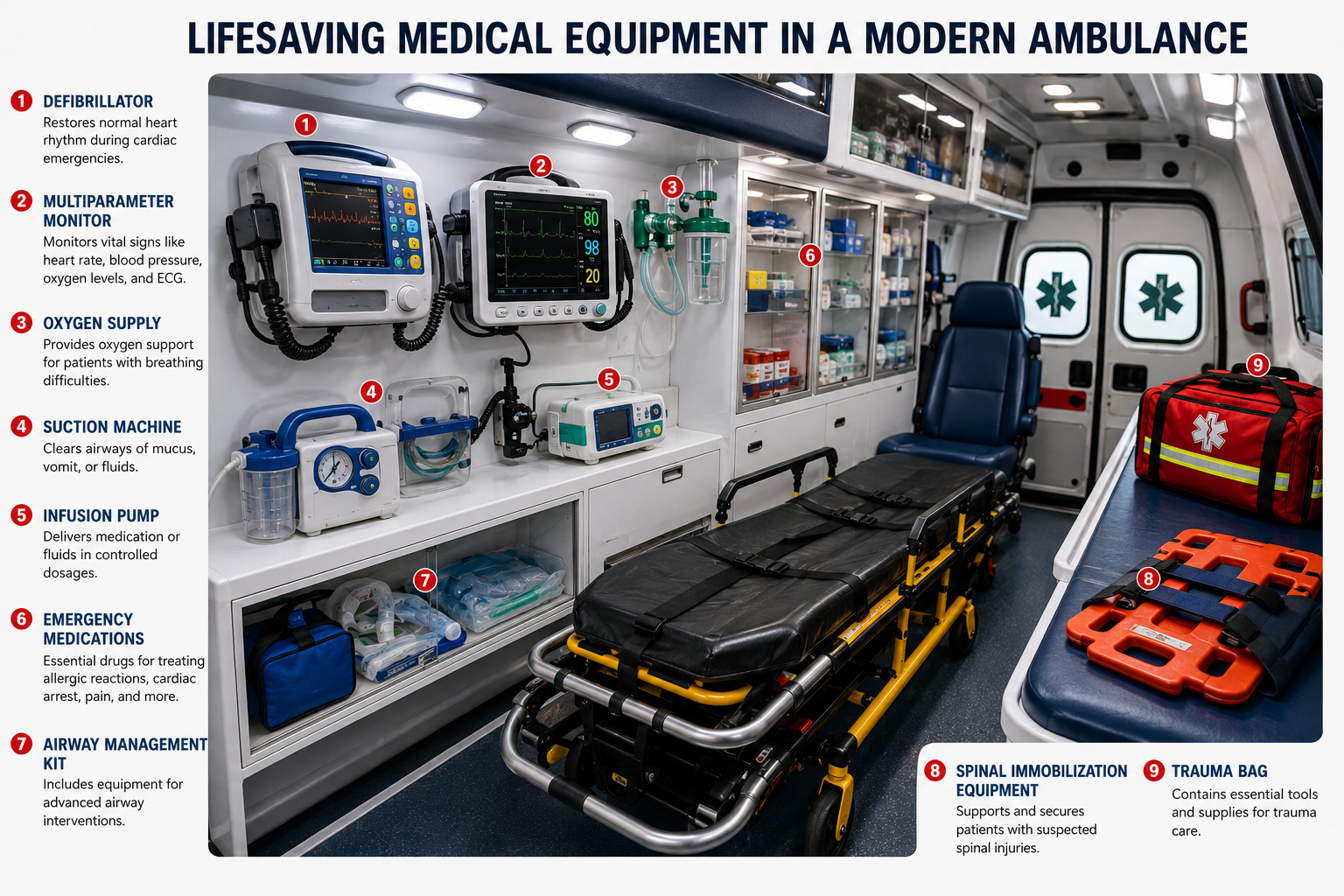
When most people see an ambulance speeding by with sirens blaring, they often think only of urgency and transportation. However, a modern ambulance is far more than a vehicle—it is a mobile emergency care unit equipped with advanced medical technology designed to stabilize critically ill or injured patients before they arrive at the hospital.
In emergency medicine, the first few minutes can determine a patient’s outcome. The equipment inside an ambulance, combined with the expertise of trained emergency medical professionals, plays a crucial role in preserving life and preventing further deterioration.
This article highlights three critical aspects of pre-hospital emergency care: transport ventilators, cardiac monitors, and the essential lifesaving equipment found inside a modern ambulance.

- The Role of a Transport Ventilator
A transport ventilator is a portable life-support device used to assist or completely support breathing in patients who are unable to breathe adequately on their own.
How It Works
The ventilator delivers controlled oxygen and air into the lungs while regulating:
Respiratory rate
Tidal volume (amount of air delivered)
Oxygen concentration
Ventilatory pressure
Advanced transport ventilators are capable of providing intensive care-level respiratory support even while the patient is being moved between facilities or transported to the hospital.
Common Indications for Use
Transport ventilators are commonly used in patients with:
Severe respiratory distress
Acute asthma exacerbation
Pneumonia or respiratory failure
Trauma affecting the airway or lungs
Cardiac arrest
Reduced consciousness or sedation
Why It Is Important
Adequate oxygen delivery is essential for the survival of vital organs such as the brain, heart, and kidneys. Even a few minutes of inadequate oxygenation can lead to irreversible organ damage or death.
A transport ventilator ensures continuous respiratory support during critical moments, significantly improving the patient’s chances of survival until definitive hospital care is available.
- The Importance of a Cardiac Monitor
A cardiac monitor is one of the most indispensable tools in emergency and critical care medicine. It continuously monitors the electrical activity and vital signs of a patient in real time.
Key Functions
Modern cardiac monitors can:
Display electrocardiogram (ECG) rhythms
Measure heart rate
Monitor oxygen saturation (SpO₂)
Measure blood pressure
Track respiratory rate
Many advanced monitors also function as defibrillators, allowing emergency responders to deliver lifesaving electrical shocks when necessary.
Life-Saving Applications
Cardiac monitors help detect and manage serious medical conditions such as:
Heart attacks (myocardial infarction)
Dangerous arrhythmias
Cardiac arrest
Severe electrolyte abnormalities
Shock and circulatory collapse
Why It Matters
In emergency medicine, rapid diagnosis saves lives. Cardiac monitors allow paramedics and emergency physicians to quickly identify life-threatening abnormalities and initiate immediate treatment.
Early recognition and intervention significantly improve survival outcomes, particularly in cardiac emergencies where every second is critical.
- Essential Equipment Inside a Modern Ambulance
A properly equipped ambulance carries a wide range of medical devices and emergency supplies to manage different clinical situations effectively.
Airway and Breathing Equipment
These tools help maintain adequate breathing and oxygenation:
Oxygen cylinders
Bag-valve masks (BVM)
Suction machines
Oral and nasal airway adjuncts
Nebulizers
Transport ventilators
Circulatory and Cardiac Equipment
These devices support circulation and cardiac care:
Cardiac monitor/defibrillator
Automated External Defibrillator (AED)
Intravenous (IV) fluids
Infusion sets and syringes
Trauma and Immobilization Equipment
Used to stabilize injuries and prevent further harm:
Stretchers
Spinal boards
Cervical collars
Splints and bandages
Trauma dressings
Emergency Medications
Modern ambulances carry essential medications for managing emergencies such as:
Severe allergic reactions
Asthma attacks
Pain management
Cardiac emergencies
Seizures and resuscitation
Monitoring and Diagnostic Tools
These assist in rapid patient assessment:
Pulse oximeters
Glucometers
Thermometers
Blood pressure devices

Modern ambulances are essentially mobile emergency rooms designed to provide immediate lifesaving interventions before hospital arrival.
Highly trained emergency medical personnel use advanced equipment to:
Stabilize critically ill patients
Prevent deterioration during transport
Initiate urgent treatment
Improve survival outcomes
In many emergency situations, the care delivered inside the ambulance can be the difference between life and death.
Final Thoughts
Emergency medical services are built on three critical pillars: rapid response, skilled professionals, and advanced medical equipment.
From transport ventilators that sustain breathing to cardiac monitors that detect life-threatening heart conditions, every piece of equipment inside an ambulance serves a vital purpose in emergency care.
Understanding the capabilities of a modern ambulance helps the public appreciate the sophisticated level of treatment provided even before a patient reaches the hospital.
Indeed, modern ambulances are far more than transport vehicles—they are lifesaving mobile critical care units dedicated to preserving life every single day.