
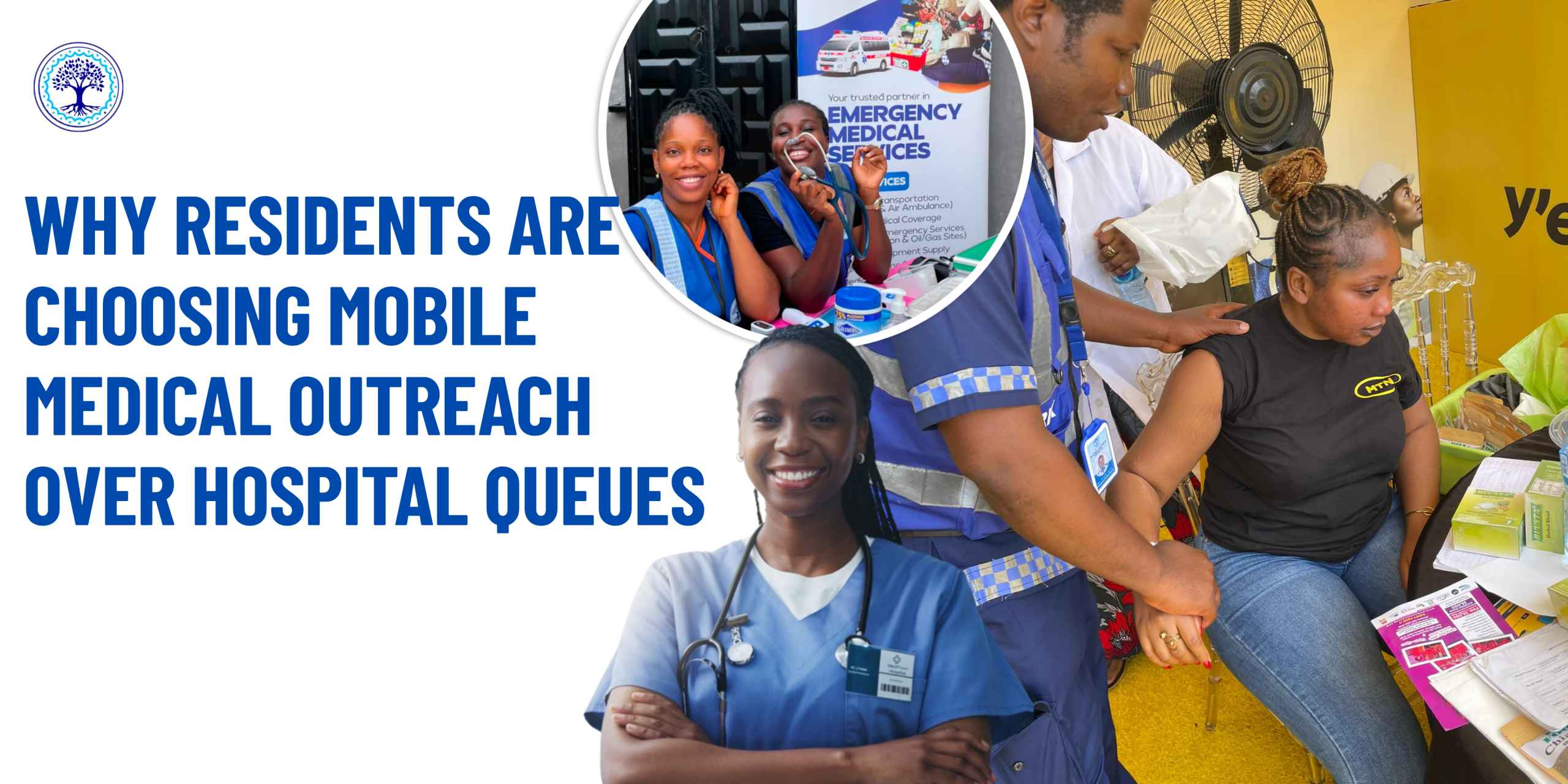
Every week, thousands of Lagos residents lose an entire afternoon standing in overcrowded hospital corridors just to see a doctor for a routine check-up or a simple prescription refill. It is no surprise that mobile medical outreach programs Lagos families can now access nearby have become the preferred alternative to that frustrating wait.
Search interest in this model has grown steadily as more people in Surulere, Ikeja, Lekki, Yaba, and beyond look for faster, more dignified ways to get quality healthcare without sacrificing an entire workday.
This article breaks down why residents are quietly walking away from traditional hospital queues, what to expect during a mobile clinic visit, which Lagos neighborhoods are being reached first, how to prepare for a scheduled outreach visit, and how your community can request one for itself.
The Hospital Queue Crisis in Lagos: What the Numbers Show
Lagos is Africa’s most populous city, and its public hospitals have long struggled to keep pace with demand. Patients routinely arrive before sunrise to secure a place in line, only to wait five, six, or even eight hours before a consultation, and that is before accounting for the return trip through some of the city’s heaviest traffic corridors.
A widely cited performance evaluation of the Lagos State Ambulance Service found that dispatch delays and overstretched emergency infrastructure remain a persistent challenge for the city’s medical response system, a problem that mirrors what happens inside general hospital waiting rooms every single day (Lagos Ambulance Performance Study).
The Lagos State Government has acknowledged the strain on its facilities and has continued to expand emergency coordination through agencies working under its command structure, including efforts to modernize dispatch and response times (Lagos State Government).
Meanwhile, national health authorities such as the Nigeria Centre for Disease Control have repeatedly stressed that overcrowded facilities increase the risk of disease transmission and delay urgent care for the patients who need it most (NCDC Nigeria).
The World Health Organization has also warned that without stronger primary and community-level care, fast-growing cities will keep experiencing bottlenecks at the hospital level rather than genuine resolution of them (WHO Universal Health Coverage).
This is precisely the gap that community-based outreach clinics were designed to close, and it explains why so many families are turning toward scheduled, localized care instead of a first-come, first-served hospital line.
What Exactly Are Mobile Medical Outreach Programs?
A mobile medical outreach program is a coordinated healthcare service that brings doctors, nurses, diagnostic equipment, medication, and ambulances directly to residential estates, markets, schools, churches, mosques, and corporate offices rather than requiring patients to travel to a fixed hospital location.
Instead of joining a queue, residents are seen on a scheduled visit, often within their own street or compound, with a fraction of the waiting time a hospital would require.
The concept is closely aligned with the World Health Organization’s long-standing guidance on primary health care, which emphasizes bringing essential services as close as possible to where people live and work (WHO Primary Health Care).
In Nigeria, the National Primary Health Care Development Agency has pushed for exactly this kind of decentralized model to reduce the burden on secondary and tertiary hospitals and to bring basic services within walking distance of more households (NPHCDA).
The Federal Ministry of Health has likewise encouraged private and community partners to fill service gaps through outreach-based delivery models, particularly in dense urban areas like Lagos where hospital capacity has not kept pace with population growth (Federal Ministry of Health Nigeria).
A well-run outreach visit typically includes blood pressure and blood sugar screening, malaria testing, basic wound care, maternal health checks, vaccination support, ambulance standby services, and referral pathways for cases that genuinely require hospital admission.
Top Reasons Lagos Residents Are Switching to Mobile Outreach Care
Time Savings That Actually Matter
The single biggest complaint about public and even many private hospitals in Lagos is the sheer amount of time lost. A worker in Surulere or Yaba who takes a half-day off to see a doctor is often risking pay, productivity, or an important meeting.
Mobile medical outreach programs eliminate that trade-off almost entirely because the service comes to the resident’s location on a fixed schedule, with most consultations completed in well under an hour, and often closer to thirty minutes per patient once the team is set up on site.
Lower Overall Cost of Care
Beyond consultation fees, hospital visits carry hidden costs: transportation across Lagos traffic, parking, informal fees, and lost income from missed work.
Outreach visits are typically bundled into a single, transparent cost structure, which makes budgeting for healthcare far easier for working-class families and for employers who want to offer a benefit without the administrative complexity of a full hospital partnership.
Reduced Overcrowding and Cross-Infection Risk
Public health researchers have long pointed out that overcrowded waiting rooms are a breeding ground for the transmission of respiratory and other communicable illnesses. Organizations such as the Centers for Disease
Control and Prevention have documented how reducing unnecessary facility crowding directly lowers the spread of preventable infections in shared indoor spaces (CDC).
By moving routine and preventive care out of hospital corridors, this style of community delivery helps protect residents who would otherwise sit for hours next to people with active infections, particularly during flu season or disease outbreaks.
Better Reach Into Underserved Communities
Health financing groups like PharmAccess have highlighted how community-based delivery models improve access for populations that historically avoid the formal hospital system due to cost or distance (PharmAccess).
Neighborhoods further from Lagos Island’s major teaching hospitals, including parts of Ikorodu, Epe, Badagry, and Alimosho, benefit enormously when qualified staff are brought directly to them instead of requiring a long, expensive commute across the mainland.
Stronger Maternal and Child Health Outcomes
UNICEF Nigeria has consistently emphasized that consistent, accessible antenatal and postnatal contact points are one of the strongest predictors of safe deliveries and healthy child development (UNICEF Nigeria).
Outreach visits that include maternal health screening give expectant mothers in areas like Ajah, Agege, and Egbeda a realistic, low-friction way to stay on schedule with checkups they might otherwise skip because of distance, cost, or simple inconvenience.
Consistent Access to Verified Medication
Because counterfeit and substandard drugs remain a documented concern in Nigeria, agencies such as the National Agency for Food and Drug Administration and Control continue to push for regulated, traceable medicine distribution channels (NAFDAC).
Reputable providers source medication through verified pharmaceutical partners, giving residents confidence that what they receive during an outreach visit is genuine, correctly stored, and appropriately dosed.
Community Trust and Local Health Data
Independent health journalism outlets such as Nigeria Health Watch have reported growing public interest in decentralized care models precisely because they build trust at the community level, where residents can ask questions, get follow-up, and see the same providers over multiple visits (Nigeria Health Watch). That familiarity is difficult to replicate in a busy, anonymous hospital queue where a patient may see a different physician every single visit.
What to Expect During a Scheduled Outreach Visit
Most community outreach visits follow a predictable rhythm that residents quickly come to appreciate. A coordinating team first confirms the date, time, and location with the estate manager, employer, or community leader. On the day of the visit, residents check in, have basic vitals recorded, and are triaged by a nurse before seeing a physician.
Anyone who needs further diagnostic work, specialist input, or hospital admission is referred immediately, with an ambulance available on site for cases that cannot wait.
This structure means the vast majority of attendees leave with a completed consultation, any necessary medication, and a clear next step, all within the same short visit that would otherwise have meant an entire day lost to a hospital queue.
Where Mobile Medical Outreach Programs Are Reaching Across Lagos
One of the most important shifts in Lagos healthcare over the past several years is geographic reach. Scheduled community health visits are no longer limited to a handful of central districts; they are actively organized across the mainland and island alike.
Coverage now regularly includes Surulere, Ikeja, Lekki, Victoria Island, Ikoyi, Yaba, Apapa, Oshodi, Mushin, Ojota, Gbagada, Magodo, Ogba, Maryland, Isolo, Festac, Amuwo-Odofin, Ajegunle, Egbeda, Agege, Alimosho, Ikorodu, Ajah, Epe, and Badagry. This matters because Lagos State, home to one of the densest urban populations on the continent, has neighborhoods with dramatically different distances from tertiary hospitals (Lagos, Nigeria).
The Lagos State Ministry of Health has recognized that geographic equity in healthcare delivery is central to its own public health goals, and outreach-based models directly support that objective (Lagos State Ministry of Health).
Development partners tracking Nigeria’s healthcare financing gaps, including the World Bank, have similarly noted that closing distance-related access barriers is one of the most cost-effective ways to improve health outcomes at scale (World Bank Nigeria).
For residents in fast-growing but historically underserved areas, a scheduled visit can be the difference between catching a health issue early and discovering it only after it becomes an emergency requiring far more expensive treatment.
Mobile Outreach vs Hospital Queues: A Side-by-Side Look
Wait Time: Hospital queues frequently run five to eight hours; scheduled outreach visits typically operate on fixed appointment windows measured in minutes, not hours.
Travel Requirement: Hospitals require a trip across Lagos traffic; outreach care comes directly to the estate, office, or place of worship.
Cost Transparency: Hospitals often carry variable, itemized charges that are hard to predict in advance; outreach visits commonly use a single bundled fee agreed on before the day of service.
Crowd Exposure: Hospitals mean shared waiting rooms with sick patients from across the city; outreach visits involve small, scheduled groups from a single community.
Follow-Up Continuity: Hospitals can mean seeing a different doctor at every visit; outreach teams frequently return to the same community repeatedly, building familiarity and continuity of care.
Emergency Readiness: Traditional queues offer limited on-site emergency response; well-organized outreach programs travel with standby ambulances and trained paramedics ready to transport serious cases immediately.
How Matrix Escorts Medical Is Leading Lagos’s Mobile Outreach Movement
Matrix Escorts Medical has built its reputation around exactly the model residents are now actively searching for: dependable mobile outreach clinics paired with rapid ambulance support. Rather than asking Lagos families to gamble on hospital wait times, the team brings screening, consultation, and emergency transport capability directly into neighborhoods across the mainland and island.
This mirrors the coordination approach used by established emergency responders in the state, including the Lagos State Ambulance Service and the Lagos State Emergency Management Agency, both of which have built their reputations on rapid, localized response rather than centralized bottlenecks (LASAMBUS; LASEMA).
It also complements the road-safety and accident-response work carried out by the Federal Road Safety Corps, since many outreach visits double as an opportunity to educate residents on emergency preparedness and basic first aid (FRSC).
For estates, corporate offices, schools, and religious organizations that want to bring a fully staffed medical visit to their own compound, Matrix Escorts Medical coordinates scheduling, staffing, medication, and ambulance standby as a single, accountable service rather than several disconnected vendors.
If your estate, office, church, mosque, or community group in Surulere, Lekki, Ikeja, Yaba, or anywhere else in Lagos wants to schedule a visit instead of relying on unpredictable hospital queues, reach out today:
| Call or WhatsApp: 08034442454
Website: www.matrixescortsmedical.com Email: matrixescortsmedical@gmail.com Ambulance Desk: matrixambulance@gmail.com Office Address: 47B James Robertson Street, Surulere, Lagos |
The Role of Preventive Screening and Community Health Data
Preventive screening is arguably the single highest-value component of any community outreach visit, because it catches conditions like hypertension and diabetes long before they become emergencies.
Nigeria’s National Bureau of Statistics has published population and health survey data repeatedly showing that non-communicable diseases are rising sharply in urban centers like Lagos, often going undiagnosed until a crisis forces a hospital visit (National Bureau of Statistics Nigeria).
Local news coverage from outlets such as The Guardian Nigeria has similarly reported on how stretched emergency departments and long queues are pushing more residents to seek preventive alternatives before problems escalate (The Guardian Nigeria).
By screening blood pressure, blood sugar, and basic vitals during a scheduled visit, providers can flag at-risk residents and refer them for further care while the condition is still manageable, rather than waiting for a full-blown emergency that lands them back in the very hospital queue they were trying to avoid in the first place.
Common Health Conditions Detected During a Scheduled Outreach Visit
Across most Lagos neighborhoods, a handful of conditions show up repeatedly once residents are actually screened rather than avoiding care until symptoms become severe. Hypertension is consistently one of the most common findings, often in patients who had no idea their blood pressure was elevated because they had never been checked outside of an emergency.
Elevated blood sugar and early-stage diabetes are close behind, particularly among residents over forty who rarely visit a hospital unless something is visibly wrong. Malaria remains a near-constant presence across Lagos, and rapid testing during an outreach visit allows for same-day treatment rather than days of worsening symptoms before a hospital trip is finally arranged.
Anaemia, particularly among pregnant women and young children, is another frequent finding, which is part of why maternal and child health checks are built into most outreach schedules rather than offered as an afterthought.
Minor wound care, skin infections, and basic musculoskeletal complaints round out the list of conditions that a well-equipped outreach team can resolve on the spot without ever requiring a hospital admission. For the smaller percentage of cases that do need further imaging, surgery, or specialist input, an on-site ambulance ensures the referral happens immediately rather than leaving the family to arrange transport on their own.
Who Should Attend a Scheduled Community Health Visit
While outreach visits are useful for almost anyone, certain groups benefit disproportionately from making them a regular habit. Adults over forty who have never had a formal blood pressure or blood sugar check are prime candidates, since these conditions are frequently silent until they cause a crisis.
Pregnant women in neighborhoods further from a major hospital, including parts of Ikorodu, Epe, and Badagry, gain enormously from consistent antenatal contact points that do not require a long, uncomfortable commute.
Children due for routine immunizations benefit from a nearby, low-stress environment rather than a crowded pediatric ward. Employers with staff who cannot easily take a half-day off for a hospital visit also see real value, since a single scheduled office visit can screen dozens of employees in the time it would take one person to complete a single hospital consultation.
How to Book a Mobile Medical Outreach Program for Your Community
Booking a scheduled visit is generally a straightforward process. A resident’s association, employer, school administrator, or religious organization contacts a provider directly, agrees on a date and expected attendance, and confirms which services are needed, whether that is general screening, maternal health checks, vaccination support, or standby ambulance coverage for a larger event.
Providers then handle staffing, equipment, medication, and logistics so that the host community only needs to supply a suitable space and communicate the schedule to residents in advance.
For estates and offices in Surulere, Ikeja, Lekki, and across greater Lagos, this coordination is exactly the service Matrix Escorts Medical provides, from the initial phone call through to the day of the visit itself.
Frequently Asked Questions
Are outreach visits as thorough as a hospital visit?
For routine checkups, screening, minor treatment, vaccinations, and preventive care, a scheduled community visit covers the vast majority of what residents actually need day to day. Cases requiring surgery, imaging, or specialist admission are referred onward, with ambulance transport arranged if necessary rather than leaving the patient to arrange their own transfer.
How much does a scheduled visit cost compared to a hospital trip?
Because outreach visits bundle transport, staffing, and basic diagnostics into one scheduled service, the effective cost per resident is usually lower than the combined expense of hospital transport, parking, and consultation fees, especially for group bookings at an estate, school, or office.
Can my estate or company request one directly?
Yes. Estates, corporate offices, schools, and religious organizations across Lagos can request a scheduled visit. Matrix Escorts Medical coordinates staffing, equipment, and ambulance standby for group bookings anywhere from Surulere to Ikorodu, and can typically confirm a date within a few days of the initial inquiry.
Do mobile medical outreach programs include ambulance support?
Reputable providers pair outreach visits with standby ambulance capability so that any case requiring urgent hospital transfer can be handled immediately rather than waiting for a separate emergency call to be dispatched from elsewhere in the city.
Which Lagos areas currently have the most active coverage?
Surulere, Ikeja, Lekki, Yaba, Victoria Island, and Ikoyi currently see the most frequent scheduled visits, though coverage is expanding steadily into Alimosho, Ikorodu, Ajah, and Badagry as demand grows and more communities request their own dates.
How far in advance should a community book a visit?
For a standard estate or office visit, one to two weeks’ notice is usually enough to confirm staffing and logistics. Larger events, such as a multi-day screening exercise for a school or religious congregation, typically benefit from three to four weeks of lead time.
Is a scheduled outreach visit safe for elderly residents and young children?
Yes. Outreach teams are trained to work with both elderly patients and children, and most visits include age-appropriate screening, from blood pressure and mobility checks for older residents to growth monitoring and immunization support for infants and toddlers. Anyone with a complex or urgent condition is referred immediately, with ambulance transport arranged on the spot.
What happens if a health issue is found that needs hospital-level care?
The outreach team stabilizes the patient, arranges an ambulance if needed, and coordinates a referral to an appropriate hospital, sharing the results of the on-site screening so the receiving facility does not have to start the diagnostic process from zero. This referral pathway is a core part of any responsible outreach program rather than an optional add-on.
Conclusion: The Shift Away From Hospital Queues Is Already Underway
Lagos residents are not abandoning hospitals altogether, but they are increasingly unwilling to lose an entire day standing in a queue for care that could be delivered closer to home.
Mobile medical outreach programs give families in Surulere, Ikeja, Lekki, and every neighborhood in between a faster, more transparent, and more community-centered way to stay healthy, catch problems early, and access emergency transport when it truly matters.
If your community, office, or place of worship is ready to bring a reliable scheduled medical visit to your own doorstep instead of another long wait at the hospital, Matrix Escorts Medical is ready to help you plan one from start to finish.
| Call or WhatsApp: 08034442454
Website: www.matrixescortsmedical.com Email: matrixescortsmedical@gmail.com Ambulance Desk: matrixambulance@gmail.com Office: 47B James Robertson Street, Surulere, Lagos |