
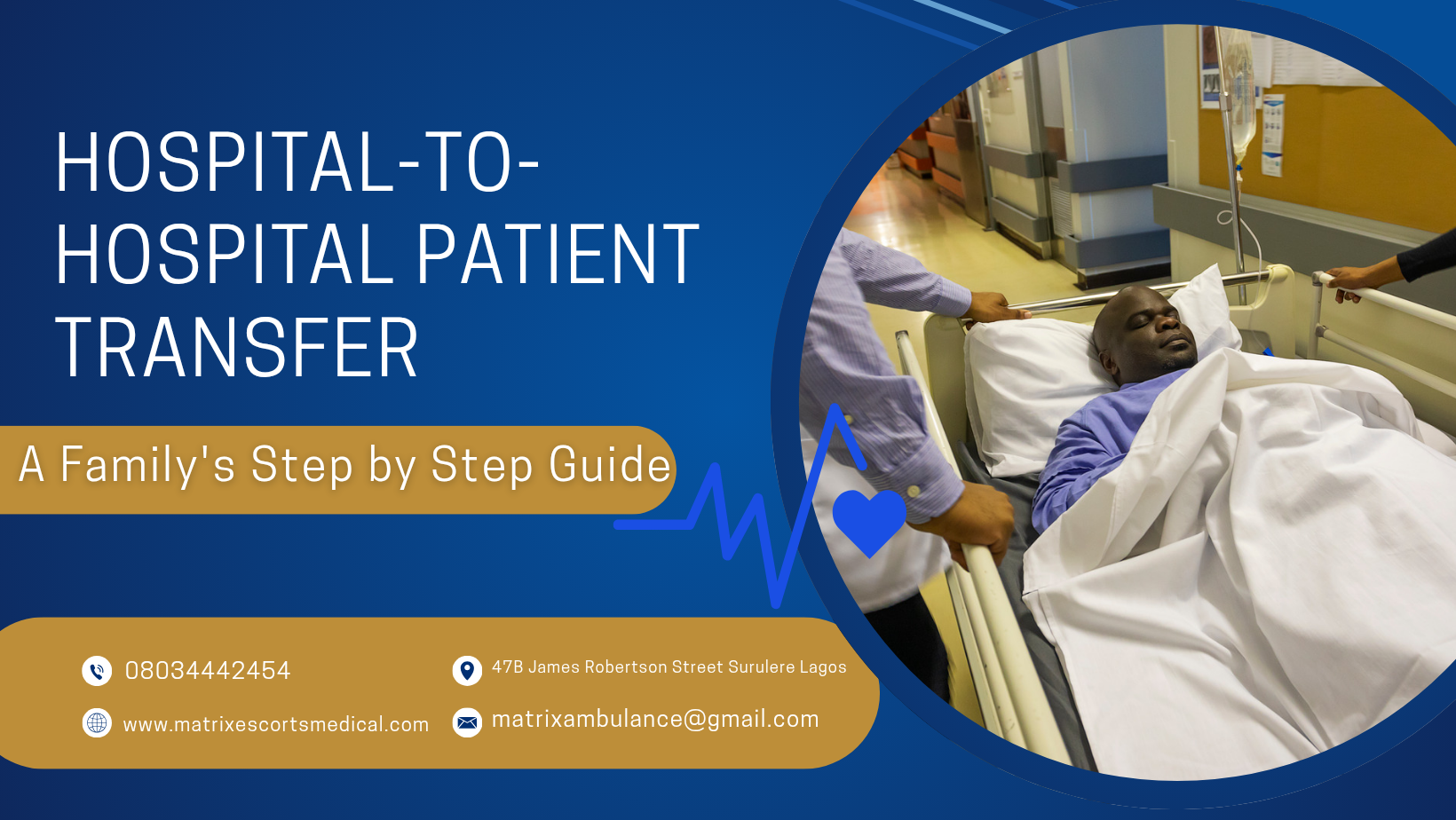
When a family member is seriously ill and the hospital they are currently in cannot offer the specialist care they need, arranging a hospital to hospital ambulance transfer Lagos becomes one of the most urgent and stressful decisions a family will face. You are already worried about your loved one’s condition. Now you must also navigate clinical consent, medical documentation, ambulance selection, and hospital coordination — often with very little time and very little guidance.
This guide is written specifically for families in Lagos who are facing this situation. It walks through each step of the hospital to hospital ambulance transfer Lagos process in plain language — from the moment a transfer is first recommended to the point at which your family member is safely handed over to the care team at the receiving hospital. It covers what to ask the doctors, what documents to collect, how to evaluate an ambulance provider, what to expect during transit, and how to prepare yourself and your family for the journey.
Lagos presents specific challenges for patient transfers: traffic congestion, variable ambulance quality, and a hospital landscape with significant differences in specialist capability across facilities, from major tertiary centres in Ikeja and Lagos Island to private hospitals across Lekki, Victoria Island, Surulere, and beyond. Understanding how the process works — and what can go wrong without proper preparation — helps families make faster, safer decisions when it matters most.
At Matrix Escorts Medical, founded by Dr. Wole Adu with extensive experience in critical care and emergency medicine, we facilitate these transfers every week. This guide reflects what we have learned from hundreds of patient journeys and the questions families ask most often.
Why Hospital-to-Hospital Transfers Happen: Understanding the Reason for Your Transfer
Patient transfers between hospitals occur when the current facility lacks the specialist, equipment, or level of care a patient’s condition requires. As Travel Care Air’s guide to reasons for hospital transfers explains, a transfer is warranted when the receiving hospital offers a significantly better chance of recovery and the risk of transport is outweighed by the clinical benefit of reaching better-equipped care.
Common Reasons for Transfer in Lagos
- A patient requires a specialist (cardiologist, neurosurgeon, oncologist, intensivist) who is not available at the current hospital
- The current facility lacks a critical care unit, operating theatre, or specific diagnostic equipment such as an MRI or CT scanner
- The patient’s condition has deteriorated beyond what the current hospital can manage
- The patient or family requests transfer to a preferred hospital for ongoing care
- A bed is no longer available at the current facility and the patient needs continued inpatient monitoring
Understanding the reason clearly matters, because it affects what level of ambulance and crew you need, how urgently the transfer must happen, and what the receiving hospital will be preparing for. The clinical case for transfer should be explained to you directly by the attending physician. If it has not been, ask.
Step 1: Confirm the Transfer Is Clinically Approved
The first and most important step is clinical authorisation. According to guidelines published in Critical Care Medicine by the American College of Critical Care Medicine, the decision to transfer a patient is the responsibility of the attending physician at the referring institution, who must confirm that patient stability has been assessed and that the benefits of transfer exceed the risks of the journey itself.
In practice, this means: before any ambulance is booked, the doctor caring for your family member should have:
- Assessed the patient’s current clinical stability and documented it in the medical record
- Contacted the receiving hospital and confirmed they have a bed available and are prepared to accept the patient
- Briefed the receiving specialist on the patient’s condition, diagnosis, and treatment so far
- Obtained the patient’s consent to transfer, or the family’s consent if the patient is unable to consent
As Nursa’s guide to hospital patient transfer best practices notes, facilities should use a standardised transfer checklist to avoid documentation and medication errors, and should ensure that both the sending physician and the receiving team are aligned on the clinical picture before the ambulance departs. If you are not sure whether this coordination has happened, ask the nurse or doctor directly before you proceed with booking transport.
Step 2: Gather the Documents Your Family Member Needs
One of the most common and preventable problems in hospital transfers is the patient arriving at the receiving facility without adequate documentation. When the clinical team at the new hospital does not have access to the patient’s notes, test results, and medication history, they are forced to repeat investigations and start from scratch — delaying definitive care and increasing the risk of medication errors.
Before the ambulance departs, request and collect the following:
- A referral letter from the sending physician addressed to the receiving team, summarising the diagnosis, treatment given, and reason for transfer
- Copies of all investigation results — blood tests, imaging reports (X-rays, CT scans, ultrasounds, MRIs), ECGs, and any specialist reports
- The patient’s complete medication chart, including current doses, timing, and any medications that have been stopped or changed during admission
- A list of known allergies and any adverse drug reactions documented during the admission
- The patient’s identification documents (national ID or passport, next-of-kin contact details)
- A signed transfer consent form, if the sending hospital uses one
This documentation requirement is emphasised in published guidelines for the inter- and intrahospital transport of critically ill patients (Critical Care Medicine journal), which state that patient status and management during transport must be recorded and filed in the medical record, with copies provided to the receiving institution. Having these documents in hand before the ambulance leaves avoids the most common cause of care delays at the destination.
Step 3: Choose the Right Ambulance for Your Patient’s Condition
Not all ambulances offer the same level of clinical capability, and choosing the wrong one for a critically ill patient is a serious risk. A prospective audit of interhospital transport of critically ill patients published in PMC, which evaluated 100 consecutive ICU-to-ICU transfers, found that circulatory or ventilatory problems can and do arise during ambulance transport, with monitoring capability limited and fewer skilled personnel available on the road compared with a hospital setting.
A separate study on the impact of mobile intensive care units on interhospital transfer quality, published in PMC, found that patients transferred by a specialised mobile ICU team experienced significantly fewer adverse events than those transferred by a standard ambulance — 12.5 per cent versus 34 per cent. The clear implication is that the specific service you choose can materially affect your family member’s outcome.
Basic Life Support (BLS) vs Advanced Life Support (ALS)
A Basic Life Support ambulance is equipped for stable patients who need monitoring and basic first aid during transport. An Advanced Life Support ambulance carries cardiac monitoring equipment, a ventilator, IV access capability, and emergency medications, staffed by a trained paramedic, nurse, or doctor. For any patient who is critically ill, unconscious, on oxygen support, or haemodynamically unstable, an ALS ambulance with a clinician on board is not optional — it is necessary.
Questions to Ask Before Booking
- Will a doctor, registered nurse, or trained paramedic be on board for this specific transfer?
- Is the ambulance equipped with a cardiac monitor, oxygen supply, and IV access capability?
- How long will the journey realistically take given current traffic conditions on the route?
- Will the driver be familiar with the route between the two hospitals and potential alternatives?
- Will the team communicate with the receiving hospital prior to arrival?
- What is the total cost, and will I receive a written quote before the ambulance departs?
Step 4: Coordinate With the Receiving Hospital Before Departure
One of the most frequent sources of delay and confusion in a hospital to hospital ambulance transfer Lagos is the receiving hospital not being fully prepared when the patient arrives. Ensuring proper pre-arrival communication is a shared responsibility between the sending clinical team and the ambulance provider — but families should also confirm it has happened.
Before the ambulance leaves, confirm the following with the medical team or the ambulance coordinator:
- The receiving hospital has confirmed in writing or by phone that it is ready to receive the patient
- The specific ward, unit, or department where the patient will be admitted has been notified
- The ambulance crew has the receiving hospital’s exact address, correct entrance point, and a contact number for the admitting team
- The receiving team has been given a verbal summary of the patient’s condition, current medications, and any known complications to prepare for
The BJA Education guide on the transfer of the critically ill adult patient stresses that a dedicated transfer service has many advantages and is the preferred method for patients requiring specialist treatment or prolonged transport — but only when the sending and receiving teams are properly aligned before departure. Communication breakdowns at this stage are one of the most cited causes of adverse events during inter-hospital transfers.
Family’s Pre-Transfer Checklist: Eight Things to Confirm Before the Ambulance Leaves
Use this checklist as a quick reference when coordinating a hospital-to-hospital transfer for a family member. Work through each item systematically before giving the ambulance team the go-ahead to depart.
| Category | What to Confirm Before the Ambulance Departs |
| Clinical consent | Confirm the attending physician at the sending hospital has documented patient stability and authorised the transfer in writing |
| Receiving hospital | Confirm the destination hospital has accepted the patient, has a bed available, and the specialist or department is briefed and waiting |
| Medical documentation | Request a full copy of the patient’s notes, test results, imaging, medication charts, and allergy list to travel with the patient |
| Ambulance crew | Confirm a doctor or registered nurse will accompany your family member, not just a driver |
| Equipment on board | Confirm the ambulance carries cardiac monitoring, oxygen, IV access capability, and relevant emergency medications |
| Family communication | Agree a single family contact who will receive updates during transit and at handover |
| Destination logistics | Know the receiving hospital’s address, entrance point, and which ward or unit the patient will be admitted to |
| Cost and billing | Get a written quote from the ambulance provider covering all charges, and clarify payment timing |
Step 5: What Happens During the Transfer — What to Expect in Transit
For families who have never been through a hospital to hospital ambulance transfer Lagos, understanding what actually happens during the journey helps reduce anxiety and allows you to set realistic expectations about timing and communication.
Continuous Monitoring
On an Advanced Life Support ambulance, the clinical crew monitors your family member’s vital signs throughout the journey — checking blood pressure, oxygen saturation, heart rhythm, and level of consciousness at regular intervals. Any deterioration is acted on immediately, and the crew may contact the receiving hospital en route if the clinical picture changes significantly.
Ongoing Treatment
If your family member is receiving an IV drip, oxygen therapy, or continuous medication infusion, this continues uninterrupted during transport. The ambulance carries sufficient supplies for the expected duration of the journey, with contingency supplies for delays.
Communication With Family
A reputable ambulance provider will have identified a single family contact point before departure and will update that person at key moments: when the ambulance departs, when it arrives at the receiving hospital, and after the patient has been handed over to the receiving team. If you are following the ambulance by car, confirm the route and the receiving hospital entrance with the crew before you leave.
Handover at the Receiving Hospital
Upon arrival, the ambulance crew provides a structured verbal handover to the receiving clinical team — covering the patient’s current vital signs, any events or changes during transit, treatments given en route, and a summary of the documentation they are transferring. As Medicine LibreTexts explains in its guide to patient transfers, nurses and paramedics must include all pertinent information when giving a hand-off report, to maintain continuity of care from the moment the patient arrives at the new facility.
Step 6: After the Transfer — What Families Need to Do Next
Once your family member has been admitted to the receiving hospital, the transfer itself is complete — but there are several practical steps families should take in the hours that follow.
Introduce Yourself to the New Care Team
As soon as the patient is admitted, introduce yourself to the nurse or doctor who will be responsible for their care. Provide your contact details, confirm that you are the primary family contact, and ask when and how the team will update you on the patient’s condition going forward.
Check That All Documentation Has Arrived
Confirm that the referral letter, test results, medication chart, and other documents have been received and are in the patient’s new medical record. If anything is missing, contact the sending hospital immediately to request it be sent through electronically or by phone.
Understand the Plan of Care
Ask the new team what the immediate plan is for your family member: which specialist will review them, what investigations or procedures are planned, and what the expected timeline is. The Agency for Healthcare Research and Quality’s guide to care transitions, which recommends family engagement as a central component of safe care transitions, advises families to ask about next steps in plain language at every stage, and to request written discharge or care planning information where it is available.
Logistics and Practical Support
If the receiving hospital is far from your family’s base in Lagos, arrange accommodation or transport in advance. Travel Care Air’s guide on preparing for hospital transfers recommends families prepare a communication plan identifying who will travel with the patient and who will remain the main contact for extended family, and also address practical logistics such as accommodation near the receiving hospital and childcare at home.
Lagos-Specific Considerations: Traffic, Hospital Coverage, and Provider Choice
Lagos presents unique conditions that families must factor into any transfer plan. Traffic on routes connecting major hospital corridors — including the Lagos-Ibadan Expressway, Third Mainland Bridge, Carter Bridge, and Apapa-Oshodi Expressway — can add unpredictable time to any journey, particularly during morning and evening peak hours.
This means that a transfer planned for a thirty-minute journey could realistically take ninety minutes or more in heavy traffic. For a critically ill patient, that added time in transit is not trivial — it represents ninety minutes of monitoring and clinical management on the road rather than in a hospital bed. This is why it is particularly important in Lagos to choose an ambulance provider whose driver is experienced in the city’s traffic patterns and alternative routes, and whose clinical crew is capable of managing any deterioration that occurs during a longer-than-expected journey.
Whether the transfer is within a single part of the city — say, from a hospital in Yaba to a specialist centre in Ikeja — or crosses the city from Lekki to Surulere, from Ajah to Gbagada, or from Apapa to Victoria Island, the principles of good transfer practice remain the same: proper clinical authorisation, complete documentation, an appropriate ambulance with a qualified crew, pre-arrival communication with the receiving hospital, and a clear family contact plan.
Guidance from credenzahealth.com on hospital transfer best practices confirms that the sending physician is primarily responsible for documenting patient stability before a transfer begins, and that families should expect this documentation as standard practice — not something they need to specifically request.
How Matrix Escorts Medical Supports Hospital-to-Hospital Transfers Across Lagos
Matrix Escorts Medical facilitates hospital to hospital ambulance transfer Lagos on a daily basis. Every transfer is staffed by qualified doctors, registered nurses, or trained paramedics, supported by properly maintained ALS equipment for continuous patient monitoring and clinical intervention throughout the journey. Before departure, our coordinators liaise with both the sending and receiving hospitals to confirm the clinical handover is prepared and that the receiving team is briefed and ready.
We cover the full geography of Lagos, including transfers involving Surulere, Ikeja, Lekki, Victoria Island, Yaba, Ikoyi, Ajah, Magodo, Gbagada, Ipaja, Agege, Festac, Apapa, and Ojo, as well as interstate transfers to Ibadan, Abuja, Port Harcourt, and beyond. For patients requiring international medical evacuation or repatriation, we coordinate air ambulance services as part of a full patient transport solution.
In addition to hospital-to-hospital transfers, Matrix Escorts Medical offers:
- Standby emergency medical services for high-risk workplaces and events
- Home medical services including doctor visits, nursing care, and patient monitoring
- Community medical outreach programmes and corporate wellness services
- Medical equipment supply for clinics and healthcare organisations
- First aid, CPR, and emergency response training through the Matrix Emergency Response Institute (MERI)
| Need a Safe Hospital-to-Hospital Ambulance Transfer in Lagos?
Matrix Escorts Medical provides medically supervised patient transfers across Lagos and beyond — staffed by trained doctors, nurses, and paramedics with properly equipped ALS ambulances available 24/7. ☎ Call: 0803 444 2454 🌐 Website: www.matrixescortsmedical.com ✉ Email: matrixescortsmedical@gmail.com | matrixambulance@gmail.com 📍 Address: 47B James Robertson Street, Surulere, Lagos |
Frequently Asked Questions About Hospital-to-Hospital Patient Transfers in Lagos
Can the family travel in the ambulance with the patient?
This depends on the ambulance provider’s policy and the size of the vehicle. Many ALS ambulances can accommodate one family member in addition to the crew, though the crew’s clinical access to the patient must take priority. Ask when you book.
What if the patient deteriorates during the transfer?
A qualified clinical crew is trained to manage deterioration in transit, including airway management, resuscitation, and medication administration. As South West CCN’s guidelines for inter- and intra-hospital transfer of critically ill patients, the crew must maintain comprehensive documentation of the patient’s clinical condition before, during, and after transport, and must be trained to establish appropriate ventilation and monitoring for the specific patient being transferred. If the patient’s condition becomes critical beyond what can be managed in the ambulance, the crew will divert to the nearest appropriate emergency department.
Do I need to pay the ambulance provider before they will transport my family member?
Practices vary between providers. Most private ambulance services in Lagos require payment confirmation before dispatch. Ask for a written quote covering all charges before agreeing, and clarify the payment method and timing to avoid any confusion at the point of departure.
What if the sending hospital tries to rush the transfer before my family member is stable?
You have the right to ask the attending physician directly to explain why the transfer is recommended now and what the patient’s current clinical status is. International guidelines, including those published in the Critical Care Medicine journal, are clear that referring facilities should begin appropriate stabilisation before transport, and that interhospital transfers occur when the benefits to the patient exceed the risks of the transfer. If you are uncertain, ask for a second clinical opinion or request that the ambulance provider’s medical coordinator speak directly with the attending physician before proceeding.
How is the cost of an interfacility ambulance transfer calculated?
Most providers price interfacility transfers based on distance, the level of clinical support required (BLS versus ALS), and crew composition. A 2026 ambulance pricing overview for Nigeria confirms that the level of medical capability is the single largest driver of cost. Always request a written breakdown before the journey begins.
Conclusion
A hospital to hospital ambulance transfer Lagos is one of the most logistically and emotionally demanding things a family can be asked to organise at short notice. The steps outlined in this guide — confirming clinical approval, gathering complete documentation, choosing the right ambulance, coordinating with the receiving hospital, understanding what happens during transit, and following up properly on arrival — are not bureaucratic formalities. They are the practical foundations of a safe transfer that gives your family member the best chance of continuity of care from one facility to the next.
In Lagos, where traffic conditions and variable ambulance quality add layers of complexity to every transfer, working with an experienced, medically staffed patient transportation provider removes the largest sources of risk. Matrix Escorts Medical has the clinical capability, the local knowledge, and the coordination experience to manage your family member’s transfer safely, with full transparency on cost and process before a single wheel turns.
| Need a Safe Hospital-to-Hospital Ambulance Transfer in Lagos?
Matrix Escorts Medical provides medically supervised patient transfers across Lagos and beyond — staffed by trained doctors, nurses, and paramedics with properly equipped ALS ambulances available 24/7. ☎ Call: 0803 444 2454 🌐 Website: www.matrixescortsmedical.com ✉ Email: matrixescortsmedical@gmail.com | matrixambulance@gmail.com 📍 Address: 47B James Robertson Street, Surulere, Lagos |